
Making Rounds
When nerve pain brought life to a halt, surgery got things moving again
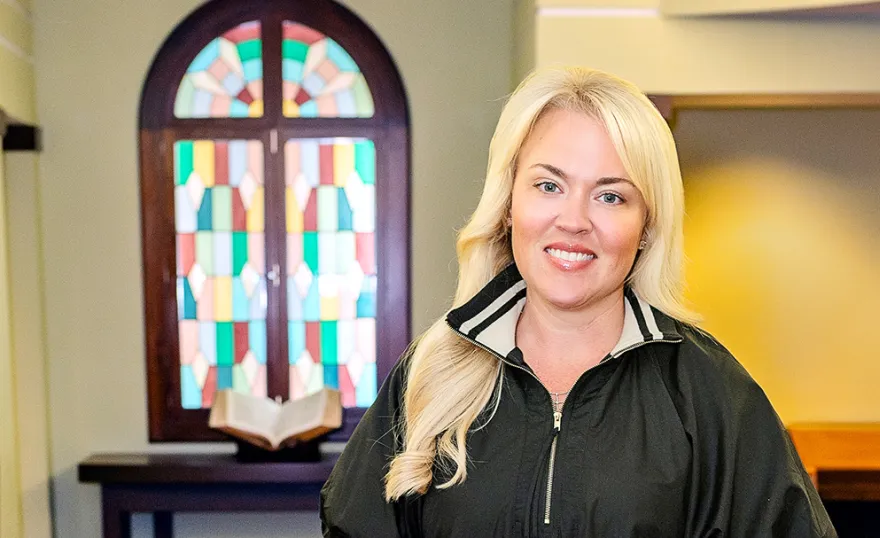
Married to her high school sweetheart, Kayla Allen is raising two teenagers who keep her on the road from one sport to the next. She juggles the endless administrative tasks of running her family’s three small businesses. And when her to-do list is done, she loves to sing.
“I’ve always sung in church, since I was a little girl,” she said. “I still sing now, and I feel like that’s my spiritual gift.”
But late in 2024, intense nerve pain made it hard for Allen to belt out a tune—or do much of anything.
“I have always carried a lot of tension in my neck and shoulders,” she said. “But this was different. I started having a throbbing pain down my left arm, radiating from my neck all the way down to the end of the tips of my fingers.”
Muscle relaxers provided some temporary relief, but the pain always came roaring back even worse than before. Soon it was unbearable.
“I was pacing back and forth at night,” Allen said. “Just throbbing, hurting. I couldn’t put a shirt on, couldn’t wash my hair. It was awful.”
She finally went to the emergency department, where an MRI revealed a herniated disc. The soft tissue between two of her vertebrae was being compressed outward, like a balloon squeezed between two hands, and pushing into the nerves that run down her arm.
“Nerve pain is very hard to explain to someone who has never had it,” said Daniel C. DeRosa, DO, an orthopedic surgeon at Valley Orthopedics & Sports Medicine. DeRose joined Cape Fear Valley in 2024 with a speciality in minimally invasive spinal surgery. “It can be very debilitating. By the time I met her, she was basically resting her head on her shoulder because she was just afraid to move.”
Allen had been referred to Dr. DeRosa after her MRI. After one conversation with him, she felt like relief was on the way.
“I said, ‘I feel like there’s a nerve just shooting pain down my arm continuously,’” she said, “and he said that’s exactly what it was. He understood exactly how it felt, and he knew what to do.”
With the problem identified, Allen was scheduled for surgery. Dr. DeRosa said in some cases like hers, the affected vertebrae have to be fused together to limit movement. But Allen’s youth and overall health made her a good candidate for a simpler solution.
“She didn’t have a lot of preexisting arthritis or a lot of other symptoms,” he said, “so she was able to be indicated for a disc replacement instead of a fusion. I like to do that for my young, active patients because it has a decreased risk of needing more surgery down the road.”
On the day of surgery, Allen recalled, she was concerned that the delicate procedure would affect her vocal cords and her ability to sing. She recalls a nurse who overheard that concern and spoke to her just before she was wheeled away.
“She found me and she said, ‘I just want to let you know that I’ll be thinking of you and praying for you as I leave today,’” said Allen. “She went out of her way to tell me that. I wish I could remember her name, because that was such a comfort to me.”
Waking up after the procedure, Allen said, she had the expected post-surgical soreness. But after weeks of suffering, her nerve pain was completely gone.
“My arm was a little tingly,” she said, “but I knew that would happen because of the damage the nerves had been through. Really, everything Dr. DeRosa told me to expect was exactly what happened, word for word.”
After weeks of physical therapy, with the pain out of her way, Allen was eager to get back to work. But she had to make some changes, based on what she’d learned about a likely cause of all of this.
“I didn’t realize it until talking to Dr. DeRosa,” she said, “but the way I had my computer monitor, it was sitting lower down. So just turning and looking at that monitor, for years, was putting a lot of stress on my neck.”
She’s moved that monitor to a better spot, and is building her whole work day around healthier habits.
“I don’t sit at my desk for hours and hours anymore,” Allen said. “I get up every hour and take a little walk, around the office or wherever. Like Dr. DeRosa told me, ‘Motion is lotion.’ So I’m happy to keep moving. I don’t ever want to feel that pain again.”


