
Making Rounds
Harnett Healthcare is not only shaping future physicians — it’s keeping them here. Several of the doctors now caring for patients in the area completed their training through the Harnett Health Family Medicine Residency Program. They trained locally, built relationships with our communities, and ultimately chose to stay and practice where they’re needed most.
The program is one of three residency programs offered through Harnett Healthcare, along with the transitional year and internal medicine residencies. All trained at Campbell University’s School of Osteopathic Medicine.
This trend is part of a broader effort at Cape Fear Valley Health which offers an additional 15 residency and fellowship programs to strengthen the physician workforce and address shortages in rural communities.
Regina Bray Brown, MD, program director of Harnett Health and Campbell University Family Medicine Residency Program, said many residents stay with the health system or continue practicing in North Carolina, which helps improve access to care across the region. She too joined the program after receiving a warm welcome from Campbell and the Harnett community.
Residency programs not only address local and statewide physician shortages but impact the country on a national level. It’s projected by Association of American Medical Colleges (AMMC) that the United States will face a physician shortage of up to 86,000 physicians by 2036. Primary care, mental health, and rural health are hit the hardest. Additionally, the population is not only growing but also living longer.
Cape Fear Valley Health had the foresight to address projected shortfalls by starting robust residency programs at Harnett Healthcare and the Medical Center, building a state-of-the-art simulation lab for physicians in training, and adding a Medical School partnered with Methodist University opening in summer 2026.
Having our residents stay on as local staffed physicians is rewarding to both Dr. Bray Brown for the program, but most importantly for the people in the communities we serve. These investments will continue to address our area’s current and future healthcare demands.
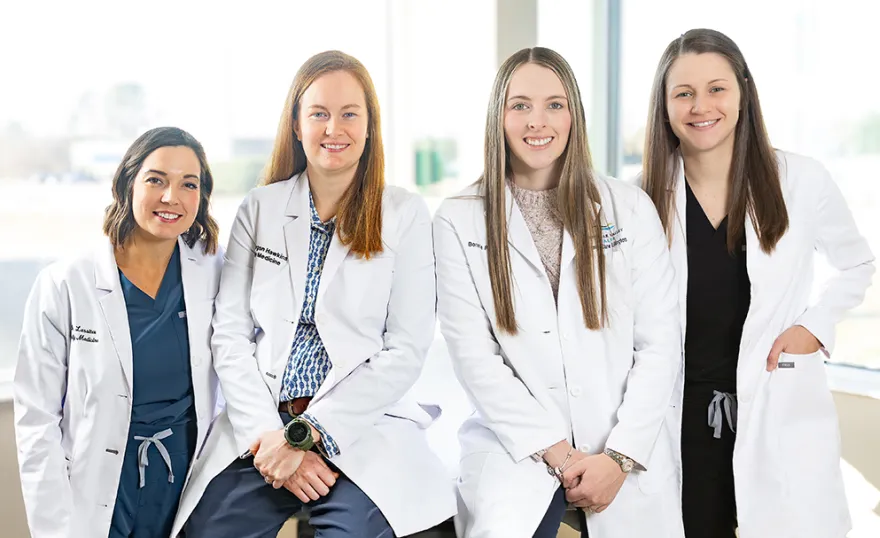
All the physicians of the Family Medicine Program who trained together and graduated last year, stayed on. Each physician brings a personal story. Shelby Rhyne, DO, said, “I grew up in a small town outside Charlotte, and I always gravitated toward science and healthcare.”
“Understanding a community is essential to understanding the person. That is what makes family medicine special.” - Regina Bray Brown, MD, program director
“I was drawn toward Campbell because of its osteopathic focus and holistic approach to patient care,” said Dr. Rhyne.
During her clinical rotations, she felt an immediate connection to the program. “I just loved the environment. I knew that was where I wanted to go for residency.” She enjoyed the challenge of rural care and said staying on felt natural. “I was very happy with the training I received, and I loved the population we served.”
Bonnie Page, DO, also found Harnett County familiar. “I am originally from a small rural area in northern Maine so coming to Lillington felt familiar to me,” she said. She chose family medicine because she enjoys caring for patients of all ages. She remembers her residency class as a turning point.
“All four of us in my residency class signed on to stay with Harnett Healthcare. It was the first time that had ever happened.” She said working in a rural community is especially meaningful because patients often face challenges with access and affordability.
For Sarah Lassiter, DO, caring for Harnett County patients is personal. “I grew up here. The people of the Dunn and Benson area are part of my upbringing,” she said. Choosing Campbell and Harnett Healthcare felt like a natural homecoming. She said her father’s difficulty finding a primary care provider shaped her motivation.
“When my dad struggled to find a doctor he trusted, I wanted to become for others what he had not been able to find.” She describes caring for her community as a privilege.
Like Lassiter, Morgan Hawkins, DO, is a Harnett County native, having grown up outside Buies Creek. She lives the rural lifestyle she now serves — raising animals on her farm and remaining deeply connected to the land and community that shaped her.
“In rural communities, patients with chronic disease are too often overlooked, whether because of limited resources or barriers to accessing primary care,” Hawkins said. “Having deep roots here, I’ve seen firsthand how critical high-quality primary care is to the health of our community.”
Hawkins said her lived experience allows her to connect with patients on a deeper level.
“When primary care is strong, the entire community is healthier,” she said. “That’s why this work matters.”
All four physicians are practicing in Harnett County primary care clinics and are taking on new patients. Dr. Rhyne is at Cape Fear Valley Primary Care – Angier, Dr. Page is at Cape Fear Valley Primary Care – Lillington, and Dr. Hawkins and Dr. Lassiter are both at Cape Fear Valley Primary Care – Dunn.
Dr. Bray Brown said the residents’ decisions to stay highlight the heart of rural medicine. “Understanding a community is essential to understanding the person. That is what makes family medicine special,” she said. She believes rural training prepares physicians to meet a wide range of needs and gives them the opportunity to build meaningful relationships with patients.
“Watching residents grow and seeing the difference they make is incredibly rewarding,” she said.
Financial support programs help physicians remain in rural North Carolina. Loan repayment opportunities through the NC Medical Society Foundation, the North Carolina Office of Rural Health, Public Service Loan Forgiveness, and the National Health Service Corps provide incentives for primary care physicians who choose underserved areas. These programs help reduce student loan burdens and make long-term rural practice more attainable.
Cape Fear Valley Health, including Harnett Healthcare, plans to add more residencies and fellowships in the coming years. Together, these programs create a strong, sustainable pipeline of medical talent committed to serving southeastern North Carolina.
For patients, the result is simple. The physicians who train here are choosing to stay, laying down roots, and improving healthcare for the communities that shaped them. Their commitment strengthens local healthcare and ensures that compassionate, high-quality primary care remains close to home.


