
Welcome
We're glad you found your way here! Choosing where to spend your Transitional Year is an important decision, and we're excited to share what makes our program such a supportive place to learn, grow, and thrive.
Our Transitional Year Program offers 16 residency positions each year. Residents gain hands-on experience across Internal Medicine, Ambulatory Care, Cardiology, Psychiatry, Pediatrics, Emergency Medicine, and Infectious Disease, with elective time to explore individual interests and prepare for advanced specialty training.
Training takes place at Cape Fear Valley Medical Center in Fayetteville, a community-based teaching hospital in southeastern North Carolina. Here, residents care for a diverse patient population with complex, high-acuity medical needs, creating a dynamic environment that offers both challenge and opportunity.
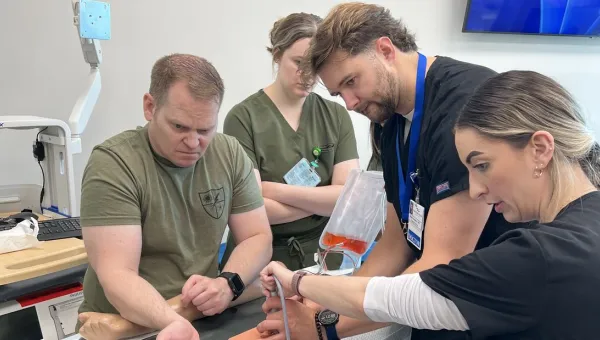
Our residents also benefit from a state-of-the-art Simulation Center, where they develop clinical skills, teamwork, and confidence through realistic training scenarios. The Methodist University Cape Fear Valley Health School of Medicine further expands opportunities for collaboration, teaching, and scholarship across our campus.
Most of all, you'll find a program that welcomes you and values you not only as a resident, but as a colleague. We are committed to supporting your growth, well-being, and success as you build a strong foundation for the next stage of your career.
Mission
The mission of this training program is to provide residents with comprehensive structured clinical, didactic, and procedural education in both inpatient and outpatient settings that will enable residents to become competent, proficient, and professional physicians. In partnership with our sponsoring institution, we are committed to educating and training diverse and culturally competent physicians prepared for any residency of their choice.
Vision
In every way, improving the quality of every life we touch.
What Our Residents Say
Feedback we have received from current residents and recent graduates:
- One-on-one teaching from attendings, rather than through layers of senior trainees
- A wide variety of rotations and broad clinical exposure
- Faculty who are consistently willing to teach
- Program leadership who are accessible and responsive
- Strong day-to-day support from our program administrator
- Opportunities to take part in GME leadership
- Networking across many departments in the health system