Making Rounds
A surprise surgery and the beauty of bouncing back
For all his 64 years, Jim Watts has always been an active guy. He lives on 65 acres in Bladen County and has never had a problem with the extensive walking and heavy lifting needed to look after that much land.
So, in August of 2023, it was a shock to find out that he’d need quadruple bypass surgery.
Like a lot of heart patients, Watts had initially dismissed his chest discomfort as a byproduct of anxiety during a stressful time. But when it became harder to ignore, he went to the emergency room.
“They took very good care of me,” he said. “They ran all the tests, and everything looked good. My blood pressure was fine; my heart rate was fine. Nothing to indicate a problem.”
When he mentioned he was going through a stressful time, the doctor agreed it may just be anxiety. But he advised Watts to follow up with his primary care doctor and a cardiologist, just to be sure. Those visits turned up nothing of concern, Watts said—until a CT cardiogram ordered by cardiologist Selvaratnam Sinna, MD.
“When he saw the results of that,” Watts said, “the first thing he asked me was, ‘How far can you walk without having to sit and rest?’ I thought that was an odd question because I felt like I was pretty much the picture of good health.”
The angiogram showed otherwise. With some diminished blood flow now apparent, Watts was scheduled for a heart catheterization to investigate further.
“So I went in there with anticipation of doing the heart cath,” Watts said, “maybe needing a stent or something like that, but that was it.”
But after that procedure, he woke up to more surprising news. The catheterization revealed four significantly blocked arteries, and he would need bypass surgery. After taking in the troubling news, Watts began listing all the things he would need to go home and take care of first.
“And they said no,” he recalled. “They said I needed to stay in the hospital until the surgery because in my condition, I really could have a heart attack at any time.”
Cardiothoracic surgeon, Robert E. Maughan, MD, performed the procedure, which reroutes blood around the blocked arteries to improve heart function. Watts said the days after waking up are still a blur, but he remembers an excellent staff that kept him informed and encouraged.
“The staff there in the ICU was absolutely invaluable,” he said. “They were awesome. There were some fantastic people who took care of me.”
After his discharge from the hospital, Watts said, the real work was in the weeks ahead. To stay motivated through his long recovery, he kept a specific goal in mind.
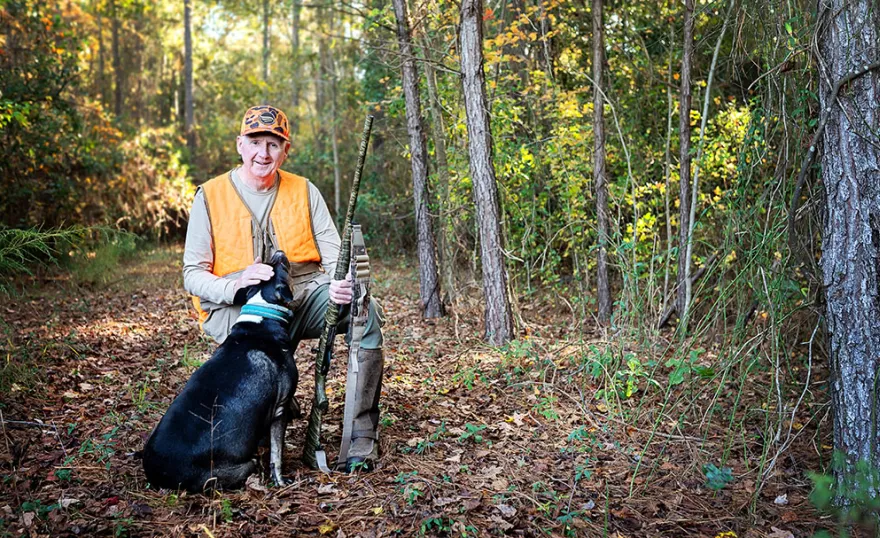
“I have an annual hunting trip to South Dakota where we go and hunt pheasant,” he said. “And before the surgery, I wanted to know if I’d be able to go to the pheasant hunt in October.”
That gave him less than 12 weeks before the trip. It was a bold ambition, but Watts knew his previous level of fitness would help to propel him.
“By the end of September, I was walking four miles a day,” he said. “It started with a lap around my yard, and then adding more laps, and then actually getting out and walking up and down the road.”
While he was undaunted by the physical challenges of recovery, Watts said he was surprised by the psychological stumbling blocks.
“It was very scary to realize that even with no symptoms, feeling just fine, I was that close to having a very serious heart attack,” he said. “And to go from lifting recliners one day to then having trouble standing up, it felt like I went from almost being invincible to being a weakling. That was hard.”
His physical progress helped to lift his spirits, Watts said, and at low points he tried to focus on the goal of getting to South Dakota. Then, about a week before the trip, he was cleared to join his friends on the hunt.
“It’s always a very special trip because the area we go to is unlike anything I’ve ever seen in this area,” he said. “You can see for miles and miles, and it’s just a beautiful landscape.”
Scenery like that has taken on new meaning for Watts since his surgery, and even working in his own yard feels a little different.
“I’m doing the same things I was before, but just enjoying it more,” he said. “I appreciate the sunset so much more now.”