
Making Rounds
Enhanced imaging and skilled neuro-intervention bring stroke healing closer to home
The recent growth at Cape Fear Valley has been hard to miss, with the new School of Medicine rising over Village Drive and the Center for Medical Education and Neuroscience Institute on Melrose Avenue. Dozens of clinics across eight counties now boast the Cape Fear Valley name, along with schools of nursing and health at multiple local colleges and universities.
But the meaning behind this expansion goes way beyond brick and mortar. Each new development aims to bring high-quality healthcare closer to home for southeastern North Carolina patients and their families.
“When we have the technology and the people we need to treat patients right here, we don’t have to send them far away to Duke or UNC,” said Mena M. Samaan, MD, Director of Neurointerventional Services. “That can make a big difference in the outcome for those patients.”
A board-certified neurologist, Dr. Samaan has advanced fellowship training in vascular neurology and endovascular neurointerventional surgery. His arrival at Cape Fear Valley earlier this year represents a major upgrade to services for complex cerebrovascular conditions such as stroke, aneurysm, arteriovenous malformation (AVM) and carotid artery disease.
“Basically, anything in the blood vessels from the neck up,” he said. “With minimally invasive procedures, we can use imaging to find the problem and address it.”
“We have a very susceptible community here,with a lot of vascular, cardiac and neurovascular problems. We have been very focused on bringing stroke care here to the next level.” - Mena M. Samaan, MD, Cape Fear Valley Neurology
It’s a big step forward for local care. Like most hospitals, Cape Fear Valley has historically given emergent stroke patients a “clot busting” medication to restore blood flow, and then quickly transferred them to larger hospitals like Duke for a thorough investigation and treatment of the cause.
“But as we say, ‘Time is brain,’” said Dr. Samaan. “Every minute, about two million neurons die. So time is of the essence, and it’s better not to spend that time going to another hospital.”
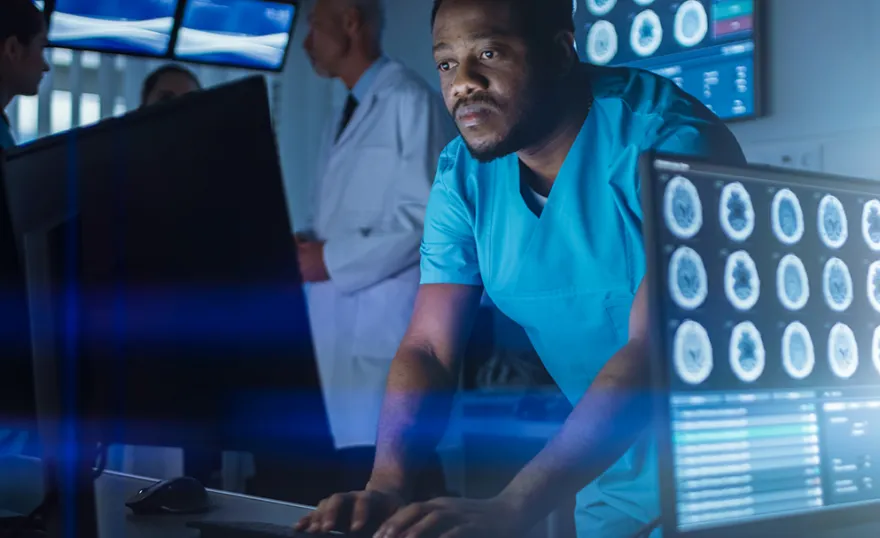
Of course, this important work can’t be done without the proper tools. Dr. Samaan is looking forward to the arrival of a million-dollar machine that will help him to clearly see the task before him. Using two rotating X-ray cameras, the biplane imaging system produces exquisitely detailed images of blood vessels and blood flow in real time. This helps doctors like Dr. Samaan to see precisely where a vessel is blocked or damaged and to quickly treat the problem.
“That will make a big difference in outcomes,” said Dr. Samaan. “We will see less disability coming from strokes, shorter hospital stays, less rehab time.”
Dr. Samaan’s work isn’t limited to strokes, of course, but they have been a major focus of his career. And because Fayetteville is nestled in the “Stroke Belt,” a portion of the United States where strokes are more prevalent, his efforts will be especially meaningful at Cape Fear Valley.
“We have a very susceptible community here,” he said, “with a lot of vascular, cardiac and neurovascular problems. So we have been very focused on bringing stroke care here to the next level.”
While settling in at Cape Fear Valley, Dr. Samaan has been impressed by the efforts to bring talented providers to the area and to upgrade care across all the health system’s services. He said the biplane imaging system is a perfect example of the investments being made in a higher level of care for the region.
“The quality team has been taking a great lead on improving the patient experience,” he said. “There has been so much effort to make significant improvements and invest in the things we need. I have seen great support from the administration, and it means a lot.”
Dr. Samaan said he was first drawn to his specialty by a desire to solve complex problems, and he’s grateful for the opportunity to do that in a supportive environment with a great team and the right tools.
“That’s really what brought me to the endovascular field,” he said. “I want to help these patients, to get them into a better position than when they came in and get them back to their family and their life.”