
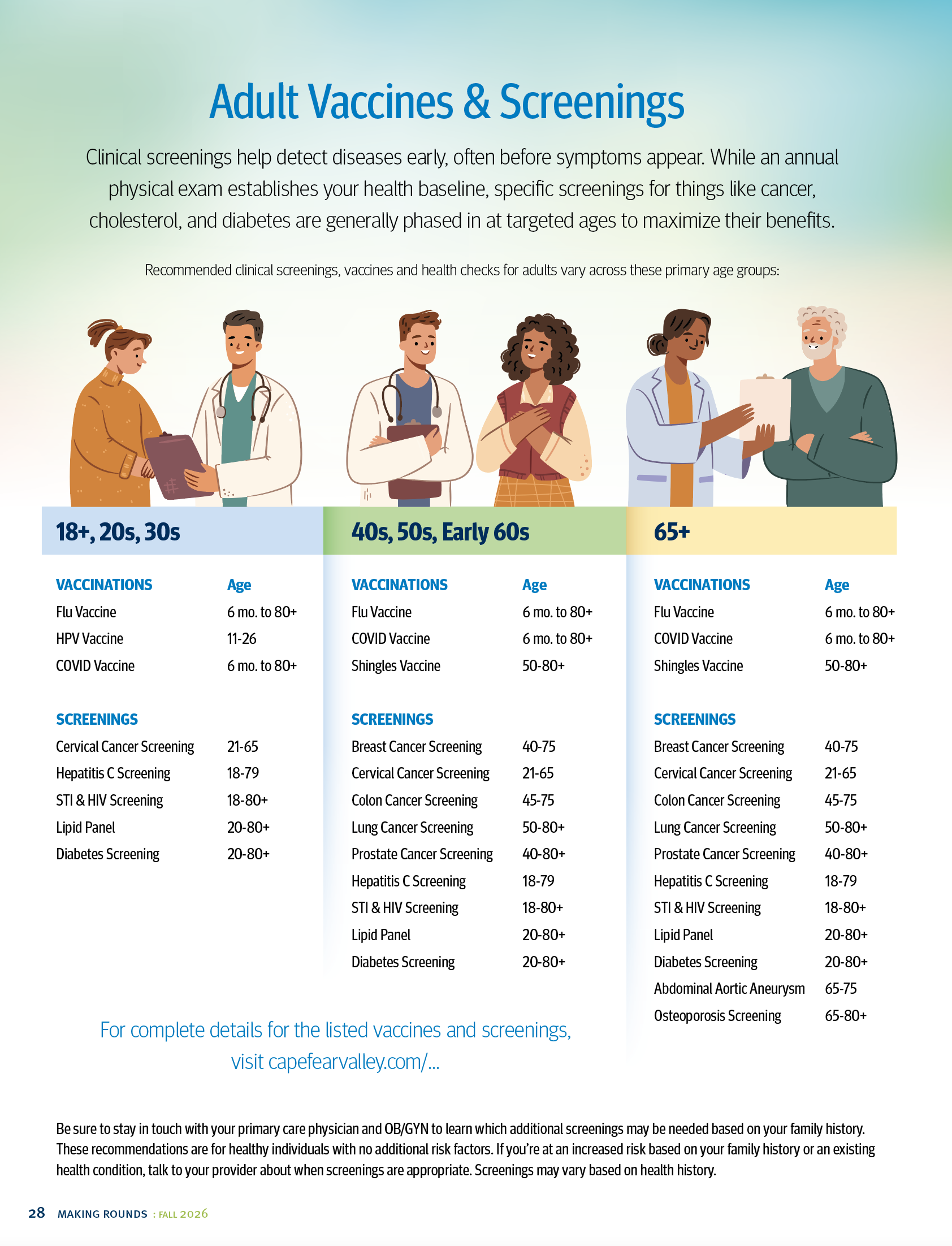
Adult Health Screenings By Age Group
Clinical screenings help detect diseases early, often before symptoms appear. While an annual physical exam establishes your health baseline, specific screenings for things like cancer, cholesterol, and diabetes are generally phased in at targeted ages to maximize their benefits.
Recommended clinical screenings, vaccines and health checks for adults vary across these primary age groups:
- 18+, 20s, 30s
VACCINATIONS- Flu Vaccine - Age 6 months to 80+
- Everyone age 6 months and over should receive the vaccine annually.
- Everyone age 6 months and over should receive the vaccine annually.
- HPV Vaccine - Age 11-26
- Two doses are recommended for people 11-15 years old and three doses for people 15-26 years old. People 26-45 years of age should speak with their provider about vaccine consideration.
- Two doses are recommended for people 11-15 years old and three doses for people 15-26 years old. People 26-45 years of age should speak with their provider about vaccine consideration.
- COVID Vaccine - Age 6 months to 80+
- Everyone age 6 months and older should receive a COVID-19 vaccine primary series and the most recent booster dose as recommended by the CDC.
- Everyone age 6 months and older should receive a COVID-19 vaccine primary series and the most recent booster dose as recommended by the CDC.
SCREENINGS
- Cervical Cancer Screening - Age 21-65
- Women should be screened every 3 years from 21-30 years old, and every 3-5 years from 30-65 based on provider’s recommendation.
- Women should be screened every 3 years from 21-30 years old, and every 3-5 years from 30-65 based on provider’s recommendation.
- Hepatitis C Screening - Age 18-79
- Adults age 18-79 should have a one-time blood test. Additional screening criteria for select populations based on CDC recommendations.
- Adults age 18-79 should have a one-time blood test. Additional screening criteria for select populations based on CDC recommendations.
- STI & HIV Screening - Age 18-80+
- Regular testing for sexually transmitted infections, including HIV, is based on assessment of risk factors, independent of age.
- Regular testing for sexually transmitted infections, including HIV, is based on assessment of risk factors, independent of age.
- Lipid Panel - Age 20-80+
- Lipid levels should be checked regularly with a blood test.
- Lipid levels should be checked regularly with a blood test.
- Diabetes Screening - Age 20-80+
- Hemoglobin A1c, which measures blood sugar levels over the past three months, should be checked regularly.
- Flu Vaccine - Age 6 months to 80+
- 40s, 50s, Early 60s
VACCINATIONS- Flu Vaccine - Age 6 months to 80+
- Everyone age 6 months and over should receive the vaccine annually.
- Everyone age 6 months and over should receive the vaccine annually.
- COVID Vaccine - Age 6 months to 80+
- Everyone age 6 months and older should receive a COVID-19 vaccine primary series and the most recent booster dose as recommended by the CDC.
- Everyone age 6 months and older should receive a COVID-19 vaccine primary series and the most recent booster dose as recommended by the CDC.
- Shingles Vaccine - Age 50-80+
- Shingrix should be given in two doses, 2-6 months apart, even if the patient already received Zostavax.
- Shingrix should be given in two doses, 2-6 months apart, even if the patient already received Zostavax.
SCREENINGS
- Breast Cancer Screening - Age 40-75
- Women should have their first mammogram at age 40 and repeat based on their provider’s recommendation.
- Women should have their first mammogram at age 40 and repeat based on their provider’s recommendation.
- Cervical Cancer Screening - Age 21-65
- Women should be screened every 3 years from 21-30 years old, and every 3-5 years from 30-65 based on provider’s recommendation.
- Women should be screened every 3 years from 21-30 years old, and every 3-5 years from 30-65 based on provider’s recommendation.
- Colon Cancer Screening - Age 45-75
- Normal colonoscopies should be repeated every 10 years; normal stool screenings should be repeated annually.
- Normal colonoscopies should be repeated every 10 years; normal stool screenings should be repeated annually.
- Lung Cancer Screening - Age 50-80+
- Annual screening for lung cancer with low-dose computed tomography (LDCT) in adults aged 50-80 years who have a 20 pack-year smoking history and currently smoke or have quit within the past 15 years.
- Annual screening for lung cancer with low-dose computed tomography (LDCT) in adults aged 50-80 years who have a 20 pack-year smoking history and currently smoke or have quit within the past 15 years.
- Prostate Cancer Screening - Age 40-80+
- All men over age 50 with at least a 10-year life expectancy and men over 40 who are at high risk should be screened. Screening includes a physical exam and PSA blood test. Frequency determined by physician based on personal risk.
- All men over age 50 with at least a 10-year life expectancy and men over 40 who are at high risk should be screened. Screening includes a physical exam and PSA blood test. Frequency determined by physician based on personal risk.
- Hepatitis C Screening - Age 18-79
- Adults age 18-79 should have a one-time blood test. Additional screening criteria for select populations based on CDC recommendations.
- Adults age 18-79 should have a one-time blood test. Additional screening criteria for select populations based on CDC recommendations.
- STI & HIV Screening - Age 18-80+
- Regular testing for sexually transmitted infections, including HIV, is based on assessment of risk factors, independent of age.
- Regular testing for sexually transmitted infections, including HIV, is based on assessment of risk factors, independent of age.
- Lipid Panel - Age 20-80+
- Lipid levels should be checked regularly with a blood test.
- Lipid levels should be checked regularly with a blood test.
- Diabetes Screening - Age 20-80+
- Hemoglobin A1c, which measures blood sugar levels over the past three months, should be checked regularly.
- Flu Vaccine - Age 6 months to 80+
- 65+
VACCINATIONS- Flu Vaccine - Age 6 months to 80+
- Everyone age 6 months and over should receive the vaccine annually.
- Everyone age 6 months and over should receive the vaccine annually.
- COVID Vaccine - Age 6 months to 80+
- Everyone age 6 months and older should receive a COVID-19 vaccine primary series and the most recent booster dose as recommended by the CDC.
- Everyone age 6 months and older should receive a COVID-19 vaccine primary series and the most recent booster dose as recommended by the CDC.
- Shingles Vaccine - Age 50-80+
- Shingrix should be given in two doses, 2-6 months apart, even if the patient already received Zostavax.
SCREENINGS
- Breast Cancer Screening - Age 40-75
- Women should have their first mammogram at age 40 and repeat based on their provider’s recommendation.
- Women should have their first mammogram at age 40 and repeat based on their provider’s recommendation.
- Cervical Cancer Screening - Age 21-65
- Women should be screened every 3 years from 21-30 years old, and every 3-5 years from 30-65 based on provider’s recommendation.
- Women should be screened every 3 years from 21-30 years old, and every 3-5 years from 30-65 based on provider’s recommendation.
- Colon Cancer Screening - Age 45-75
- Normal colonoscopies should be repeated every 10 years; normal stool screenings should be repeated annually.
- Normal colonoscopies should be repeated every 10 years; normal stool screenings should be repeated annually.
- Lung Cancer Screening - Age 50-80+
- Annual screening for lung cancer with low-dose computed tomography (LDCT) in adults aged 50-80 years who have a 20 pack-year smoking history and currently smoke or have quit within the past 15 years.
- Annual screening for lung cancer with low-dose computed tomography (LDCT) in adults aged 50-80 years who have a 20 pack-year smoking history and currently smoke or have quit within the past 15 years.
- Prostate Cancer Screening - Age 40-80+
- All men over age 50 with at least a 10-year life expectancy and men over 40 who are at high risk should be screened. Screening includes a physical exam and PSA blood test. Frequency determined by physician based on personal risk.
- All men over age 50 with at least a 10-year life expectancy and men over 40 who are at high risk should be screened. Screening includes a physical exam and PSA blood test. Frequency determined by physician based on personal risk.
- Hepatitis C Screening - Age 18-79
- Adults age 18-79 should have a one-time blood test. Additional screening criteria for select populations based on CDC recommendations.
- Adults age 18-79 should have a one-time blood test. Additional screening criteria for select populations based on CDC recommendations.
- STI & HIV Screening - Age 18-80+
- Regular testing for sexually transmitted infections, including HIV, is based on assessment of risk factors, independent of age.
- Regular testing for sexually transmitted infections, including HIV, is based on assessment of risk factors, independent of age.
- Lipid Panel - Age 20-80+
- Lipid levels should be checked regularly with a blood test.
- Lipid levels should be checked regularly with a blood test.
- Diabetes Screening - Age 20-80+
- Hemoglobin A1c, which measures blood sugar levels over the past three months, should be checked regularly.
- Hemoglobin A1c, which measures blood sugar levels over the past three months, should be checked regularly.
- Abdominal Aortic Aneurysm - Age 65-75
- Men between 65 and 75 years old who have ever smoked should have a one-time screening. Men between 65 and 75 years old who have never smoked should be screened based on family risk factors.
- Men between 65 and 75 years old who have ever smoked should have a one-time screening. Men between 65 and 75 years old who have never smoked should be screened based on family risk factors.
- Osteoporosis Screening - Age 65-80+
- Women should have their first DEXA bone scan at 65, repeated as determined by their physician. Other individuals should be screened based on risk factors.
- Flu Vaccine - Age 6 months to 80+
Be sure to stay in touch with your primary care physician and OB/GYN to learn which additional screenings may be needed based on your family history.
These recommendations are for healthy individuals with no additional risk factors. If you’re at an increased risk based on your family history or an existing health condition, talk to your provider about when screenings are appropriate.
Screenings may vary based on health history.