
Making Rounds
Sun exposure can open the door to skin cancer — and it’s not always easy to spot
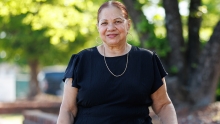
If you grew up in the 80s and 90s, you might relate to how Lauren Hodges describes the summers of her youth.
“I was just covered in baby oil, baking in the sun,” she said. “We had a pool in the back yard, and I was always in it or right by it.”
In constant pursuit of that perfect golden glow, she regularly supplemented her poolside hours with a few minutes in the tanning bed at a local salon.
“Even in the summer,” she said. “If I didn’t have time to lie in the sun, I’d just go to the tanning bed for a quick dose. I can’t ever remember wearing sunscreen back then.”
Years later, Hodges said, she was starting to question those choices. She had learned about the connection between sun exposure and skin cancer and started monitoring her moles and freckles for troubling changes.
“I had a spot on my stomach that I was concerned about,” she said. “It was getting darker and bigger, and it looked asymmetrical to me.”
Hodges went to Cape Fear Valley Skin Health for a professional opinion and found there was indeed a problem — but it wasn’t on her stomach.
“There was a spot under my eye,” she said. “Just a little white spot I hadn’t given any thought to. And it turned out to be a basal cell carcinoma.”
That’s one of three types of skin cancer: basal cell carcinoma, squamous cell carcinoma and melanoma. While melanoma is the most dangerous because of its capacity to spread to other organs, it is also often the easiest to spot. The “ABCDEs of Melanoma” can help you remember what to look for:
A is for asymmetry: Take notice if the two sides of a mole don’t match up.
B is for border: Instead of a tidy, even border, melanoma may have scalloped or notched edges.
C is for color: Two or more colors in the same mole might signal a problem.
D is for diameter: Look for anything larger than ¼ inch.
E is for evolving: Notice any changes in size, shape, color or texture.
These guidelines are what Hodges had in mind when she asked about the spot on her stomach. But the other two types of skin cancer — including the one under her eye — tend to have a subtler appearance.
“Squamous cell carcinoma and basal cell carcinoma typically present almost like a sore that doesn’t heal,” said Emily Townsend, PA-C, of Cape Fear Valley Skin Health. “It may look almost like a pearly bump, something that blends in more with the skin around it.”
Because skin cancer isn’t always so easy to see, Townsend recommends annual skin checks for anyone with a history of excessive sun exposure or a family history of skin cancer. Regular visits make it easier to find and treat a potential problem.
“If we find something that looks atypical,” she said, “we can biopsy it right there in the office and then send it off to pathology to find out exactly what it is. Then that determines what route to take for treatment.”
In Hodges’ case, when the biopsy revealed basal cell carcinoma, she learned she would need to have it surgically removed.
“It was a small spot,” Hodges said, “so it was just a little tender for a while after the surgery. But it’s not something I’d want to do again if I could help it.”
Because of that, Hodges said, her sun exposure habits have definitely changed.
“Now I’m a sunscreen girl,” she said. “I’m a hat girl. I still love the sun, but I go out there covered.”
While Hodges’ pale skin and history of sun exposure put her at a high risk for skin cancer, Townsend emphasized that the risk isn’t limited to lighter complexions or sunnier summers.
“Wear your sunscreen,” she said, “even when you’re not at the beach, and even if you don’t burn easily. Skin cancer doesn’t discriminate.”